
How to become a lash technician in Chișinău: from course to clients
A beautiful set of lash extensions shows in two seconds. The road to it takes longer: a technique learned properly, the first sets on models, a portfolio and clients who come back. Below is the real path of a lash technician in Chișinău, step by step, with no stories about easy money.
What a lash technician actually does
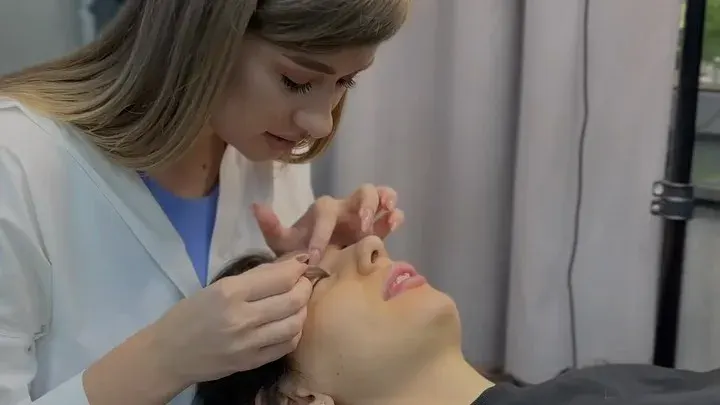
From the outside the job looks simple: fine lashes glued onto natural ones. In reality, every extension goes onto one single natural lash of the client, a short distance from the eyelid, with just the right amount of adhesive. A full set means hundreds of movements repeated with the same precision, and one appointment usually takes about two hours.
The client lies with her eyes closed and trusts that nothing will sting and nothing will stick together. That is why the job needs three things at once: steady hands, patience and a good understanding of the natural lash. Without the last one, the first two don’t help much.
The basic course: four days that lay the foundation
At the studio, the basic lash extensions course lasts four days and starts from zero, with the first pair of tweezers in your hand. The full day-by-day programme is on the lash extensions course page; here is its logic in brief:
- the basics — lash anatomy, materials, hygiene and contraindications;
- isolation and the natural 1D effect — your first complete set on a model;
- volume — fans from 2D to 6D and what natural lashes can carry;
- effects, fills and the client — KIM, KYLIE, EYELINER, LAMI LASH, WET, adding lashes, correct removal and your portfolio.
There is practice on real models on all four days, the group is small, and the course’s digital guide stays in your account on mymarafet.md, so you can go back to it once you work on your own. The certificate is given at graduation, after the final assessment.
Isolation and the growth cycle: everything starts here
Ask an experienced technician what is hardest at the start and the answer is almost always the same: isolation. For every extension you separate one natural lash from its neighbours. If two lashes stay glued together, they grow at different rhythms, pull on each other and the client feels discomfort. Everything else depends on isolation, which is why the course gives it a whole day.
The second core topic is the growth cycle. Natural lashes constantly fall out and renew, and an extension falls together with the lash it sits on. Once you understand this, you can explain to a client why she loses a few lashes a day and why a thin lash cannot carry a heavy extension. That is exactly why volume is chosen for her own lashes, not only for the photo she brings.
“Lash extensions are not only about a beautiful result right away. What matters is technique, attention to detail and respect for the natural lashes, so that the result is comfortable, clean and right for your eyes.”
From the studio’s experience
After the course: models and first sets
The certificate is a beginning, not the finish line. In the first weeks after the course your hands need repetition, and repetition comes from working on models: friends, acquaintances, people who know you are starting out and are patient with a longer appointment. Every set teaches you something: where you used too much adhesive, where the lashes are not parallel, where the length doesn’t suit the eye.
A few habits that help you grow faster:
- check every set at the end, lash by lash, with a spoolie;
- ask the model to come back in two or three weeks, to see how the set has worn;
- write down the lengths and curls you used, so you can compare results;
- ask the client how she felt on the bed, not only whether she likes the look.
Your portfolio: before and after photos
Most first paying clients arrive because of photos. That is why the course also covers before / after photography and building a portfolio. The rule is simple: same light, same angle, a clean eye, no filters. An honest photo of a well-isolated 1D set convinces more than a spectacular volume set shot with effects.
Start with the natural effect. Plenty of clients want discreet lashes, and clean classic sets build your reputation. Volume and effects come once your hand is confident with isolation.
Your body, two hours per set
People rarely talk about this, but it matters: you work bent over the client, arms raised, for hours at a time. Positioning the client and yourself is a separate topic on the first day of the course, because a back that hurts after the third appointment of the day shortens a career faster than any technical mistake. The height of the bed and chair, the lighting and breaks between clients are part of the job, not details.
Clients who come back, and who the course is for
Lash extensions have one advantage for the technician: the client comes back. Fills are done every 2–3 or 3–4 weeks, depending on the client and the lash growth phase, because natural lashes fall out and renew and the volume needs refreshing. A happy client becomes a regular booking, and a client who leaves with discomfort does not return. That is why the quality of your first sets matters more than their number.
The basic course is designed for three situations: complete beginners, technicians who already do 1D–2D and get stuck at volume, and brow artists who want a second service with clients who come back regularly. If you come from brows, the road is similar to the one described in our article on the brow artist career in Moldova; if you are still choosing a field, first read the six questions to ask before you pay for a course.
The course is taught by Mariana, the studio’s lash extensions technician. To find out when the next group starts, write to us in the chat on the site, on Messenger or on Instagram; the other programmes are on the MY MARAFET courses page.
FAQ
Can I learn lash extensions with no beauty experience?
Yes. The basic course starts from zero, with the first pair of tweezers in your hand, and lasts four days, with practice on real models every day.
Who teaches the lash extensions course?
Mariana, the studio's lash extensions technician and the course instructor. The group is small, so she can work with every student.
Do I get a certificate after the course?
Yes, at graduation, after the final assessment. The course's digital guide stays in your account on mymarafet.md.
Updated