
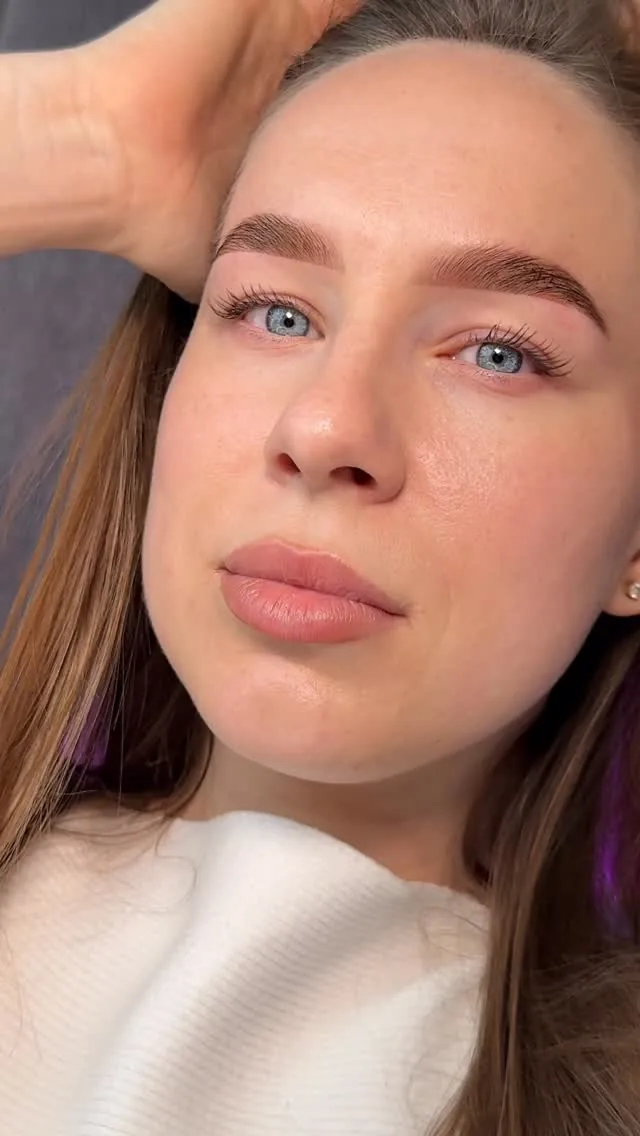
Winter, Dry Skin and Patchy Brow Tint
The same client, the same artist, the same shade — and yet in January the result is not the one you got in June. Nothing has changed in the treatment: what has changed is the skin we are tinting. Winter is the only season that obliges us to change our products, and the reason is a very simple one.
What the cold does to the skin on your brow
Cold air outside and the radiator indoors do the same thing between them: they dry. The skin loses water, the surface layer starts to flake, and the brow area is among the first to react, because it is the part we moisturise least often.
Winter is coming, it gets cold outside, and your skin dries out. As a result, the brow tint comes out patchy.
From the studio’s experience
And if the skin flakes, the colour leaves with it. That is not a metaphor: the pigment sits in the very layer that is coming away, so within two or three days you get lighter areas that read as patches. On oily skin it works differently — there the sebum washes the pigment out quickly, whatever the season.
The product changes with the season
On dry skin we work with neither henna nor tints that need well-hydrated skin, because that is exactly where the patches appear. In winter we move to a gentler product that settles evenly on dehydrated skin, the trade-off being that it holds for less time than the summer option.
It is a fair exchange: an even colour that lasts a little less, instead of an intense one that breaks into patches after three days. Your artist tells you at the consultation what she is working with that day and why. The differences between the products, by skin type, are set out at length in our article on lamination, henna or tint.
The hydration that starts two weeks earlier
The one thing that genuinely changes the result does not happen in the chair, it happens at home, in the fortnight before:
- your face cream goes over the brow as well, it does not stop at the edge of it;
- your face mask goes on the brow area too;
- in the evening, a nourishing oil on the hairs, after cleansing;
- no scrub and no cleansing brush on the brow area;
- moisturising does not start straight after tinting, but once the day of restrictions has passed.
Winter adds one detail of environment as well: a humidifier, or simply a bowl of water on the radiator, changes more than any expensive cream.
The holidays: why December fills up in November
December is the month that brings us the most messages beginning “do you still have a free slot?”. Everyone wants fresh brows and lashes for the holidays, in the same ten days. The outcome is predictable: the days before Christmas and New Year go first, usually as early as November.
If you have a particular date in mind, reserve your place a few weeks ahead. Better still: move the treatment to the beginning of December, when the diary is open and freshly done colour looks immaculate for two or three weeks anyway.
Hats, hoods and fresh brow lamination
After lamination the hairs stay soft and flexible for a while, and mechanical friction damages them — which is why we ask you not to sleep face down in the pillow for the first few days. In winter the same rule has a second application: a hat pulled down over the brows and a hood rubbing at the forehead do exactly what the pillow does, only ten times a day.
That does not mean giving up your hat. It means wearing it a little higher for the first few days and brushing the hairs once you take it off. What the treatment does and does not do, plus the three-month rule, are on our page about brow lamination.
Lashes in winter: moving from cold to warm
Lashes have a seasonal problem of their own: the temperature difference between the street and indoors, plus the damp from your scarf and your own breath. On extensions that means condensation and hairs that tangle if you do not brush them; on laminated lashes it simply means the evening oil is welcome.
There is only one practical rule: the brush lives in your bag, not in the bathroom drawer. A quick brush once you are indoors solves almost everything. And if you wear glasses, wipe them carefully: the fogged-up frame and the hand pushing it back up your nose land, dozens of times a day, right on the lash line.
The ideal calendar, November to February
November is the month of hydration and bookings: you start the routine at home and secure your slot for December. December is the month for colour treatments, ideally in the first half. January is when skin is at its driest in the whole year, so it is the month in which we most readily accept a gentler product. February brings back the normal rhythm, with touch-ups every 3–4 weeks.
Prices and durations for each option are in the price list, and holiday slots are reserved through booking.
FAQ
Does the price change depending on the product?
The price depends on the treatment and on your artist's level, not on the brand of the tint. Brow shaping with tint is from 420 MDL and the henna version from 450 MDL — changing the product within the same category does not change the rate.
Can I have lamination in winter?
Yes, the season is not a contraindication. The contraindications stay the same all year: irritated or flaking skin in the area, a recent peel, known allergies, hairs that are curly or grow downwards. And the three-month rule between lamination appointments still applies in winter.
How far ahead should I book for the holidays?
From November. The days before Christmas and New Year are taken first, and in the second half of December free windows are rare. If you can be flexible, the first half of the month is far more comfortable for both of us.
Updated