
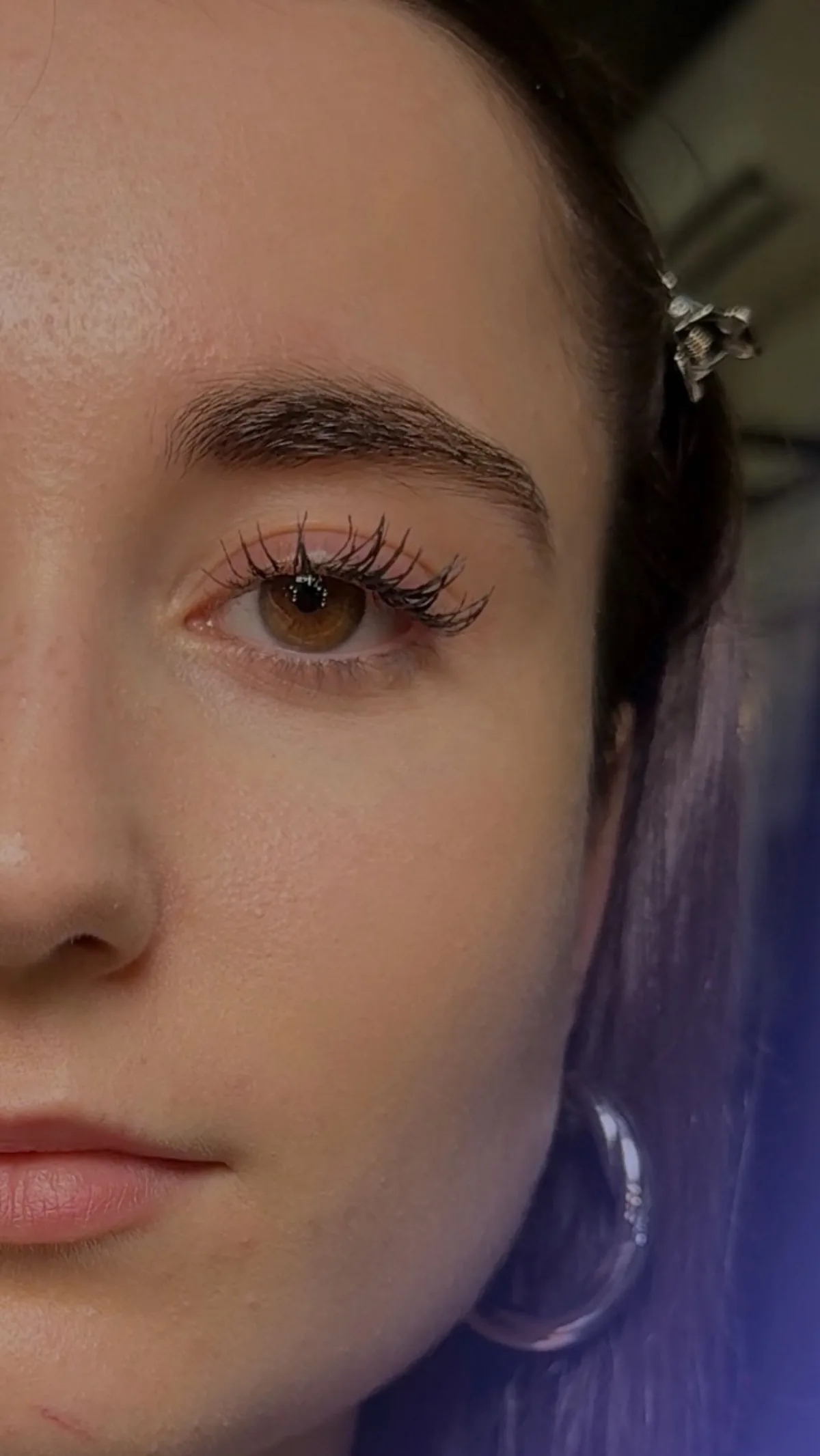
Why Brow Tint Comes Out Patchy
You leave the studio with immaculate brows, and the next day the colour is patchy: one area held, another vanished, the tail washed off first. It is not necessarily a mistake in the treatment. In most cases the answer lies in your skin — and it is an answer you can change.
Tint does not sit on the skin, it sits in it
When we tint brows, the pigment settles in two different places: on the hair, and in the surface layer of the skin. The hairs hold the colour far longer; the skin holds it only for as long as its surface layer stays in place. From the moment the skin starts to renew, the pigment leaves with it.
That is where the difference you see in the mirror comes from: the brow does not fade evenly but patch by patch, wherever the skin exfoliated faster. And that is also where the honest limit of the job lies.
An artist can give you a beautiful shape and choose the perfect shade. But nobody can work miracles or do the impossible. To get a beautiful, even colour, it is important that your skin is well hydrated.
From the studio’s experience
Dehydrated skin: cause number one
On dry or flaking skin the tint lifts away with the flakes — sometimes within a few days. On oily skin the sebaceous glands are active and wash the pigment off quickly. On normal skin, henna holds around 12 days on the skin and up to a month on the hairs.
So it is not a matter of “bad tint”, but of the surface it is working on. Skin that is hydrated, smooth and not flaking takes the pigment evenly and keeps it predictably. Everything else is a lottery.
What to do in the two weeks before your appointment
- moisturise the skin of the brow itself, not just the area around it — your face mask goes over it too;
- moisturise between visits, not on the day of the treatment: pigment will not grip freshly oiled skin;
- stop using scrubs and mechanical peels on the brow area;
- drink water and allow for the season: in winter the skin dries out faster;
- tell your artist which products you use on your face, especially acids and retinol.
The last few days before the appointment are exactly the ones in which you stop intervening aggressively in the area. The rest of the preparation is about a steady routine, not a single evening.
The mistakes at home: brow soap, scrubs, foundation
We have a client who came back visit after visit with the same problem: tint that only went on in patches, skin dry and flaking in places. Until one day it all came out even. There was no miracle — she had simply stopped using the brow soap she had been applying daily at home.
Soap-textured setting products dry the skin out if they are used to excess. A scrub on the brows removes precisely the layer that holds the pigment. And foundation applied over the brows loads the hairs and changes the way the colour reads. In short: what you put on the area every day matters more than you think.
What your artist changes when the skin is dry
Choosing the product is not a matter of taste but of skin type. On dry skin we do not tint with henna and we do not use Bronsun — we go with Elan, because it settles evenly on dehydrated skin. The trade-off is that Elan holds for less time. We accept that knowingly: better an even colour that lasts a shorter while than a patchy one from day one.
If the skin is so dry that it is already flaking, no option will hold immaculately — and we tell you that beforehand, not afterwards. You will find the detailed comparison between products in our article on henna or tint for your brows.
Peels, retinol, acids: the pause you need
An aggressive chemical peel leaves behind dehydrated skin that reacts unpredictably to pigment. In the same way, retinol and retinoids applied to the forehead change the pace at which the skin renews itself. We postpone the treatment if you have recently had a chemical peel or a retinoid treatment, if the area is irritated, has broken skin, eczema or sunburn, or if you know you are allergic to tint, henna or lamination components — when needed we do a patch test 24–48 hours beforehand.
The short consultation at the start of every visit exists for exactly this: to find out what has happened to your skin over the past few weeks.
When the patches really are down to the treatment
There is also the opposite situation, and honesty requires us to name it: a shade chosen wrongly for your undertone, a processing time that was too short, a product unsuited to your skin type, or mistaken care in the first 24 hours can all give uneven colour. For the first 24 hours after tinting, avoid water, steam, saunas and hot baths, and wash your face gently.
If the result is not what we discussed, call us. We would rather see you back in the studio than have you hunting for explanations online — booking takes a couple of minutes, and brows are the house speciality.
FAQ
How long does tint hold on the skin compared with the hairs?
On normal skin, henna holds around 12 days on the skin and up to a month on the hairs. On dry skin it exfoliates away with it, and on oily skin sebum washes it off faster.
Can I moisturise my brows right before the treatment?
No. Moisturising is done between visits, so that your skin is in good shape for the appointment; applied just beforehand, cream stops the pigment gripping evenly.
Does henna last longer than tint?
As a rule yes, because it leaves pigment on the skin too, not only on the hair. But on dry or flaking skin henna is not the right choice — there we go with Elan, which settles evenly even though it holds for less time.
Updated