
Why Not to Tweeze Your Brows at Home | Chișinău
We are not here to tell you off. Almost every woman who walks into the studio has been through a phase of doing her own brows, and plenty of them came to us precisely because they were afraid of artists. There are, though, a few technical reasons — not moral ones — why the result at home so rarely matches the one in your head.
1. You never see your whole face in the mirror
When you lean in towards the mirror you see one brow, close up, from a single angle. Your artist sees the whole face from a metre away, with both brows in the same frame and the natural asymmetry of your features in plain view. Those are two completely different sets of information, and you cannot build a balanced shape out of the first one.
The right shape is not decided on the brow itself but on the structure of the face — which is why every appointment begins with drawing the outline, before the tweezers come anywhere near. How that structure is read is explained at length in our piece on brow architecture.
2. A shape breaks in thirty seconds and takes weeks to come back
A hair pulled by mistake from the top line of the brow does not go back. The growth cycle takes no notice of how much of a hurry you were in, and filling the gap can take a good few weeks, sometimes months. In the studio the hardest work is never the “from scratch” kind — it is the kind where we wait, alongside the client, for what was removed at home to grow back.
Uneven density is the other frequent consequence: hairs taken year after year from the same spots leave a brow that is fuller on one side and sparse on the other.
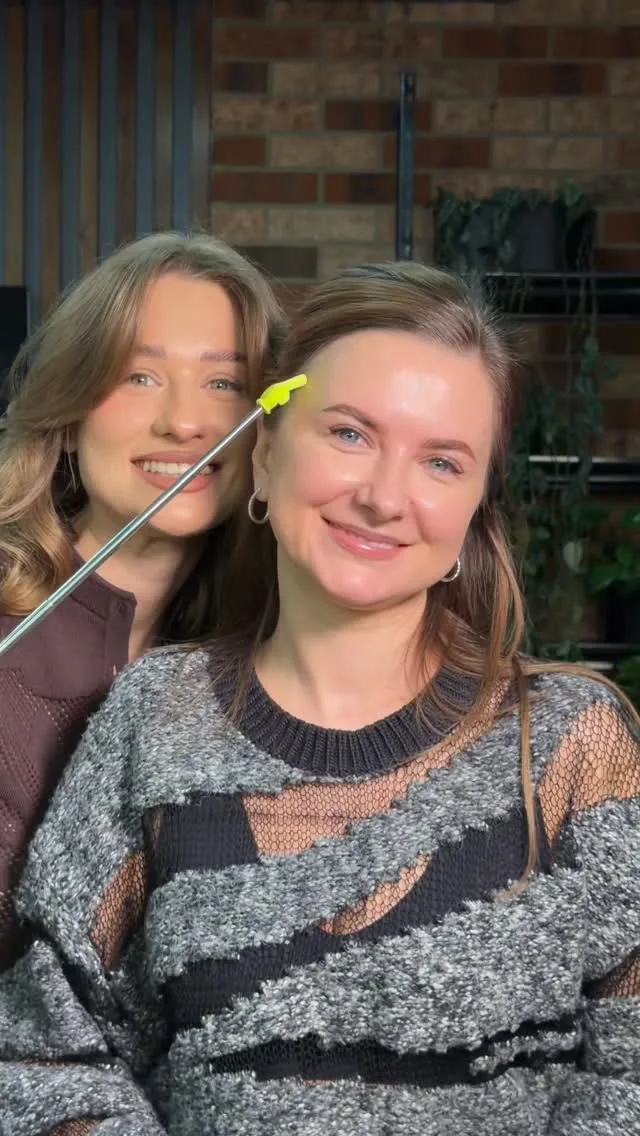
Our client used to tweeze her own brows at home, because she was afraid an artist would ruin them.
From the studio’s experience
3. Colour: where those charcoal-black stripes come from
Brow tint is not chosen by how it looks in the pot. The final shade depends on your undertone, on how porous the hair is and on your skin type — the same box, applied in exactly the same way, gives three different results on three clients. Without a mix, without the right percentage and without a suitable developer, the “just like the photo” expectation usually ends in two stripes far darker than you wanted.
Add to that the processing time, which is calculated rather than guessed, and the strip of skin that picks up extra pigment the moment the product strays outside the outline.
4. Home lamination kits
Here the conversation stops being about aesthetics. Lamination formulas contain active chemicals that work on the hair and on the skin underneath it. Applied without knowing the structure of the hair, the pH of the product and the timings of each step, you can not only miss the result you wanted — you can do harm to the skin of your face and to your brows.
There is also a limit no kit gets past: the direction of a hair can be changed by 45–60 degrees at most. A hair that grows downwards does not turn into one that grows upwards, in the studio or at home.
5. What you can safely do at home
The upkeep routine is entirely yours, and it matters more than you think:
- brush morning and evening, in the direction of growth;
- setting gel in the morning, nourishing oil at night;
- moisturise the skin on the brow, not only the skin around it;
- no scrub, no foundation and no powder on the hairs;
- at most, one stray hair below the lower line of the brow, where the shape is obvious — never from above.
The top of the brow is what gives the arch its height and the face its expression. That is where things go wrong fastest and get put right slowest, so our rule is a simple one: nothing comes off the top at home.
6. What we can repair, and how long it takes
It depends what happened. An overworked shape or a line that went astray is usually corrected in a single visit, sometimes with a subtle thinning that evens out patchy density. A shade that came out too dark can be softened, though not instantly. Gaps left by hairs removed over and over again need time and a plan spread across two or three visits, in which we take off far less than you would imagine, precisely so the shape can rebuild itself.
If the hairs above the brow bother you often, a cleaner alternative is threading: it lifts the hair precisely, without dragging at the skin, and it suits sensitive skin too.
7. Your first visit, if artists frighten you
The fear is legitimate. “I left my brow appointment in tears” is a sentence we have heard more often than we would like, and one bad experience explains perfectly why somebody would rather reach for the tweezers in the bathroom. So a first visit with us starts with a conversation, not with tweezers: you tell us what happened before, what you do not want repeated and what shape you have in mind. We draw the outline, you approve it, and only then do we work.
You do not need to let your brows grow out for months before that first visit — we start from the shape you have now and refine it gradually. If you want to know what to look for when you choose a studio, we have a checklist, and when you are ready you will find us on the booking page.
FAQ
Can I remove just the hairs underneath my brow?
One stray hair, where the lower line is obvious, does no harm. The trouble starts when you begin to "tidy up" the whole underside: the brow climbs, the arch flattens and your expression changes. Nothing comes off the top at home.
How long should I let the hairs grow before my first visit?
There is no need to leave them untouched for long. We start from the shape you have now and refine it gradually, visit by visit. If you are in the middle of a bigger repair, your artist will tell you at the first appointment how many visits she expects.
Can a ruined shape be repaired?
Most of the time, yes — but not always in a single visit. An overworked shape is corrected on the spot, uneven density is balanced with a subtle thinning, and gaps left by hairs removed again and again need growing time. At the consultation we tell you honestly what can be done and how long it will take.
Updated