
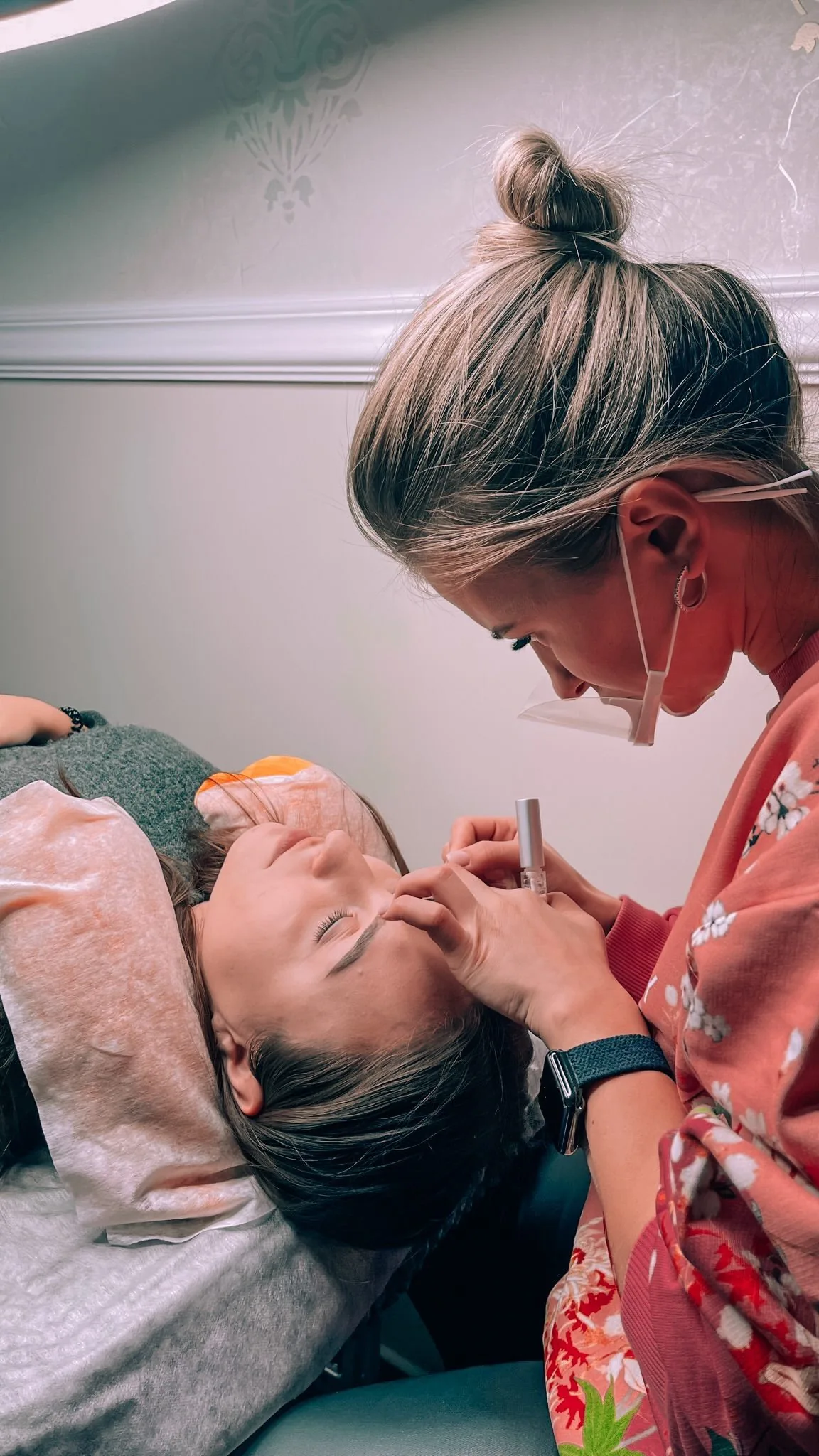
Brow Thinning: Will My Brows Go Bald? Myth Explained
If your brows are thick, bushy and a little unruly, you know the question that stops the tweezers mid-air: “what if I end up with no hairs left?” It is the fear we hear most often in the chair. The short answer is no — and below we show you exactly why, and the criteria we use to decide how much comes out.
What thinning really is (and what it is not)
In ordinary brow shaping we work the outline: we draw the shape that suits your face and take out the hairs that fall outside it. Thinning goes inside the brow and selectively removes hairs from its mass — the ones that overlap, the ones growing in every direction, the ones too long or too stiff to sit with the rest.
The shape stays exactly as it was. What changes is the density, and the way light falls across the brow. That is why we talk about thinning as a sculpting technique rather than a “trim”: we are not shortening your brow, we are giving it air.
Thinning does not mean “less” — it means more finesse, more elegance, more visual balance. We do not cut and we do not spoil; we sculpt.
From the studio’s experience
“Won’t my brows go bald?” — why they will not
The fear comes from picturing a pair of tweezers working at random in the middle of the brow. In reality hairs are not taken from one single spot, and they are not taken “as they come”. Your artist works point by point, only where the density is so high that the brow reads as one compact block with no internal drawing.
The second reason is biological: brow hairs have their own growth cycle and renew constantly, so a thinned area does not stay empty. That is precisely why the treatment is repeated at the natural correction interval, around three to four weeks, and no more often — so that nothing accumulates.
And the third: thinning is not done on every brow. If your hairs are sparse, fine or patchy, the treatment has no business there — and we tell you that straight away.
Who it suits: thick, curly, long or stiff hairs
The criteria we use in the chair are concrete:
- very thick brows, with hairs overlapping in several layers;
- curly or wavy hairs that refuse to sit in the direction given to them;
- long hairs that step outside the outline no matter how you brush them;
- stiff, undisciplined hairs that lift the brow and make you look like you are frowning;
- light and shadow distributed unevenly inside the brow.
That last point deserves its own explanation, because it is the least known of them all.
The light-and-shadow problem: when the middle is darker than the tail
Naturally, a brow is lightest at the head, near the bridge of the nose, and darkens gradually towards the tail. That gradient is what gives the gaze its softness. For some clients it runs the other way round: the darkest area is the head or the middle of the brow, because that is exactly where the hairs are densest and overlap the most.
The result is a brow that looks “heavy” in the middle and fades towards the tail, and an expression that reads as stern. No tint repairs this, because it is not a colour problem, it is a density problem. Thinning corrects it: we take hairs out of the mass in the dark area, keep the ones that draw the outline, and the gradient returns to where it belongs.
Thinning or plain shaping: two different things
Brow shaping takes around 20 minutes and starts at 250 MDL. Shaping with thinning takes 30 minutes and starts at 300 MDL — the difference is not “more hairs removed”, it is time and decisions: every hair inside the brow is judged separately. Thinning for men starts at the same rate, 300 MDL.
If this is your first visit, it helps to know that the shape is drawn before the tweezers touch anything. Only once you agree with the drawing do we start removing hairs — and that is also when we decide together whether thinning is needed or whether classic shaping is enough. We wrote at length about choosing the right shape in our guide to brow architecture.
How long it lasts and how often it is repeated
The effect holds until the removed hairs grow back — in practice, the same rhythm as an ordinary correction, three to four weeks, varying from client to client with growth speed, density and brow shape. It is not a treatment that “builds up”: at every visit we reassess what has grown and what needs to come out.
Thinning pairs well with tinting, because a brow with air in it takes colour more evenly. It can also be done on its own, with no colour at all, if all you want is order in the hairs. Every duration and rate is listed on the price list.
When we do NOT thin
We postpone or decline the treatment if your brows are already sparse or patchy, if there is irritation, broken skin, eczema or sunburn in the area, if you have recently had a chemical peel or a retinoid treatment on the forehead, or if you know you are allergic to the products used — when needed we do a patch test 24–48 hours beforehand. During pregnancy and breastfeeding we talk it through first, then decide.
Sometimes the right answer is not “less” but “differently”: on long, curly hairs we choose thinning with shaping and daily styling instead of lamination, because lamination does not look harmonious on that type of hair. The technique is taught on day two of the beginner brow course, alongside tweezing and correction with wax and with thread.
FAQ
Does thinning ruin the natural shape of the brows?
No, because it does not work on the outline. The shape is drawn first and stays unchanged; thinning removes hairs from inside the brow, where the density is too high. If you do not like your current shape, we reshape it gradually over the next few visits.
How long until the hairs grow back?
The hairs return on their own natural growth cycle, and in practice the correction rhythm is three to four weeks. The speed differs from client to client, depending on density and hair type.
Can I have thinning without tinting?
Yes. Thinning is done on its own if all you want is disciplined hairs with no change of colour. We choose together during the short consultation at the start of your visit.
Updated