Bronsun, Elan or Henna? Your Skin Decides
“I want henna, it lasts longer.” It is the request we hear most often and, very often, the least suitable one. Choosing between Bronsun, Elan and henna is not a matter of preference but of your skin type — and the difference between an even tint and a patchy one begins right here.
Three products, three behaviours
We work with all three in the studio, because they do different things. Henna colours both the hairs and the skin, creating the effect of a fuller brow. Elan tint works fast and settles well on dehydrated skin. Bronsun leaves a luminous pigment on the skin and sits graphically, without darkening the hair.
The shade is not the main differentiator — any of them can give you a soft blonde or an intense brunette. The difference is how the product behaves on the surface you put it on.
Bronsun is not at all suitable for dry skin, even when there is no flaking.
From the studio’s experience
Oily and normal skin: Bronsun or henna
If your skin is normal or oily, you have the most freedom: you can use henna or either of the tints. Bronsun is the default choice here, because it sits graphically and leaves a luminous pigment on the skin — exactly what you need when you want a clean outline. We use it, incidentally, only after brow lamination, never before.
Henna also works very well on this skin type and has its own advantage: it holds. The drawback is that on oily skin, sebum washes the pigment off the skin faster than you would expect, even though the hairs stay coloured.
Dehydrated skin: Elan, and its trade-off
On skin that is dry but not flaking, the correct choice is Elan. It works quickly and, most importantly, gives even colour where henna and Bronsun would leave patches. The trade-off shows up in the calendar: Elan holds for less time.
It is an exchange we make knowingly and explain to you in the chair. Better a colour that looks immaculate for two weeks than one that breaks into patches on day three.
Flaking skin: what not to expect from any tint
If the skin is so dry that it is already exfoliating, every option will lift in places. It is not a fault of the product and it is not an artist’s mistake — the pigment leaves along with the layer of skin that falls away.
In that case the right answer is not “let’s choose another tint” but “let’s work on the skin first”. Two weeks of steady moisturising change the result more than any change of product. And if you are wondering what difference each product makes in the longer run, the comparison is in our article on brow lamination, henna or tint: how to choose.
Why the same shade looks different on three clients
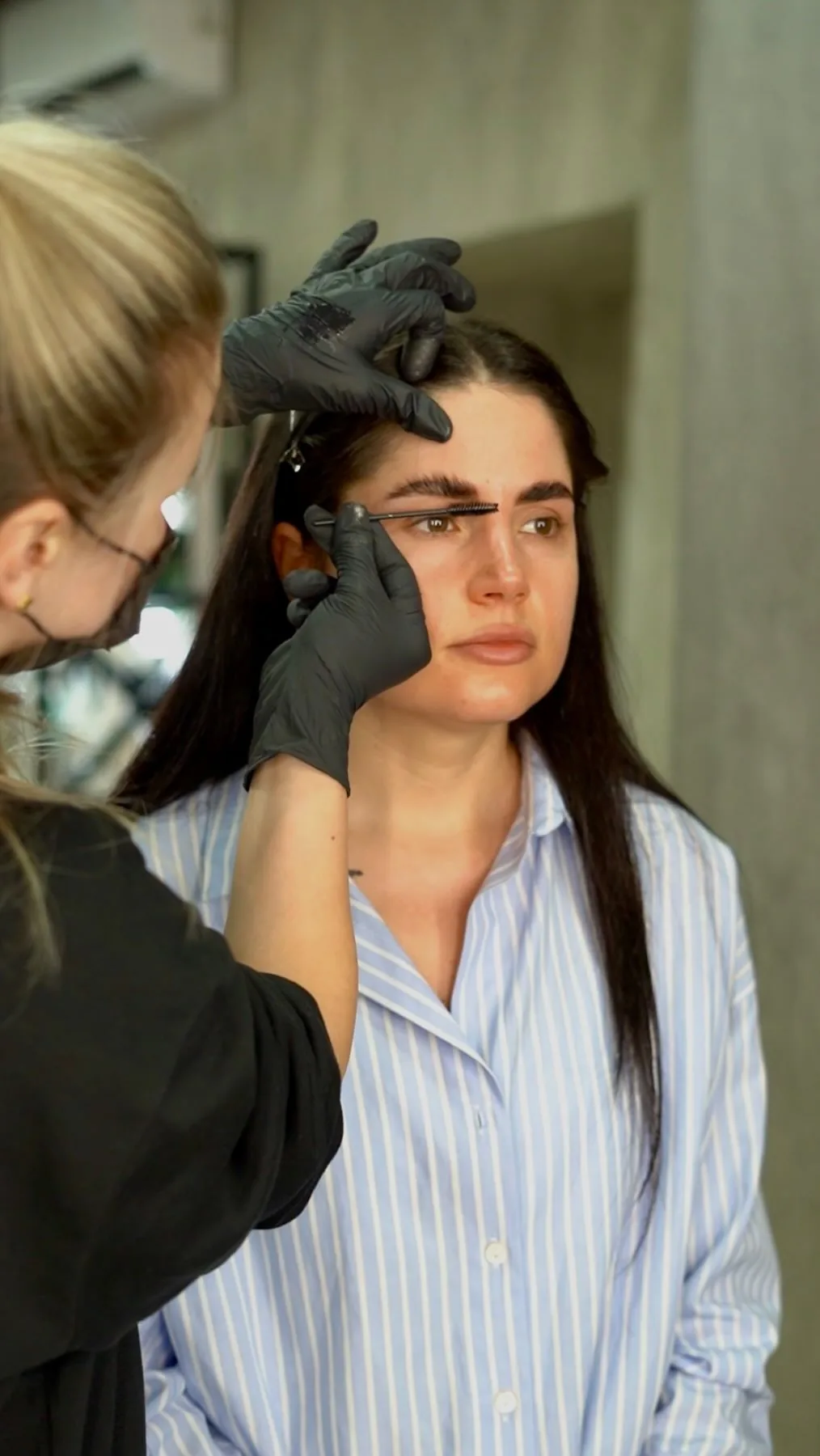
We ran the demonstration in the studio: the same shade, applied identically, on three types of skin and hair. The results were visibly different. What changes the final colour:
- the quality and tone of the skin — warm or cold;
- the density of the brow, and how much of the colour comes from the hair rather than the skin;
- the porosity of the hair — how much pigment it absorbs and how fast it loses it;
- the natural shade of the hair, especially if it is very dark;
- how hydrated the skin is on the day of the treatment.
That is why we do not promise “exactly the shade in the photo”. We promise the shade that suits you, mixed for you.
What your artist asks before choosing
The short consultation at the start of your visit is not a formality. We ask what skin type you have and how it behaves in winter, which products you use on your face — especially acids and retinol — how long your last tint held and how the colour went, whether you have any known allergies, and whether you have recently had a chemical peel. We postpone the treatment if the area is irritated, has broken skin or sunburn, and when needed we do a patch test 24–48 hours beforehand.
Only after those answers is the product chosen. The season counts too: in winter, when skin dries out, we switch to Elan more often.
What to ask for when you book, so you do not waste time
Do not ask for a particular product. Ask for the result: “I want a fuller brow”, “I want something discreet, so it does not look tinted”, “I want it to hold as long as possible, even if the shade is simpler”. Your artist translates the request into a product.
Shaping with tint colouring starts at 420 MDL and with henna at 450 MDL, in both cases taking about an hour; the full rates are on the prices page and the treatments on the brows page. If you want to learn colour theory yourself, tint, henna and working with Bronsun gel and cream are covered on day three of the beginner course.
FAQ
Can I ask for a specific product?
You can, but we will tell you honestly if it does not suit you. On dry skin, for example, henna and Bronsun leave patches however much you want their staying power — there we go with Elan.
Does henna colour the skin as well?
Yes, and that is its main difference from tint: the pigment stays on the skin too, not only on the hair, which gives the fuller-brow effect. On the skin it holds for less time than on the hairs.
Does the same shade look the same on everyone?
No. The same tint, applied identically, gives different results depending on the tone and quality of the skin, the density of the brow and the porosity of the hair. That is why the shade is mixed for each client.
Updated