
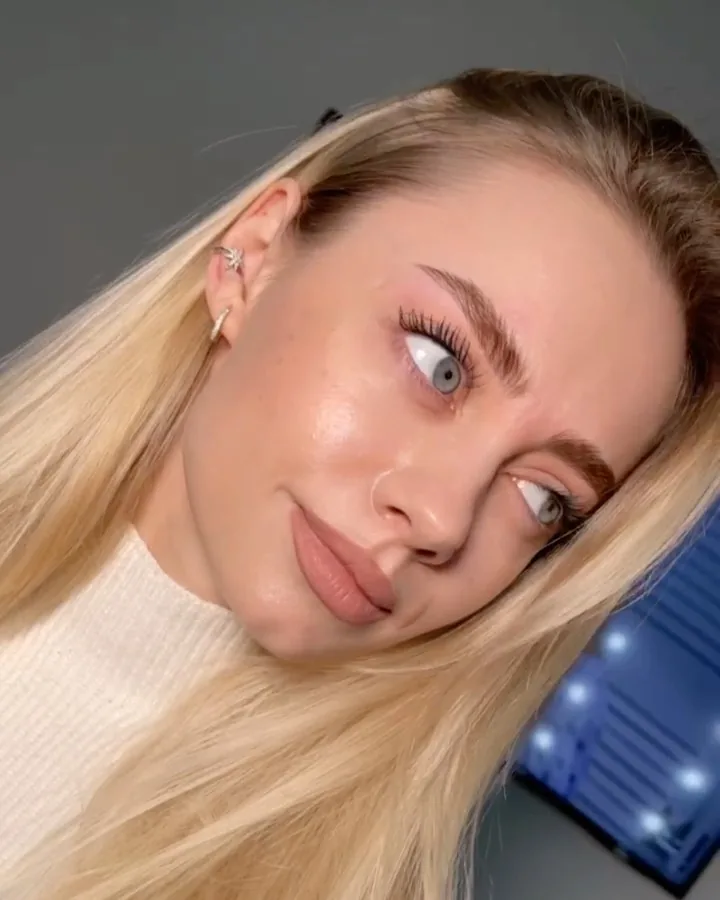
Brows for Blondes: A Shade Without the Black
There is one fear we hear from almost every blonde client, worded almost identically every time: “I don’t want coal-black brows.” The fear is well founded — a shade picked by eye, on light hair, comes out more intense than the client expected nearly every time. The good news is that a shade is not picked by eye. It is built.
Why blondes avoid tinting
On dark hair a badly chosen tint passes almost unnoticed: the hair was dark to begin with. On blonde or light brown hair the same tint jumps out immediately, because the distance between the natural colour and the result is so much greater.
There is another reason, less often discussed: blonde brows are usually finer as well, and fine hair takes up pigment faster. Two factors that add up and turn “a bit more defined” into “too much” within a few minutes of processing.
From which comes the mistaken conclusion that blondes should stay untinted. They should not — the work simply has to be done differently.
The undertone matters more than the shade
When a client shows us a photograph and says “I want this shade”, the first question is not which shade but what undertone it has: warm or cool. A cool blonde with fair skin and cool eyes calls for something entirely different from a warm, honeyed blonde.
The classic mistake is a warm, reddish shade put on a cool blonde: the result does not look black, it looks rusty and false. Equally, a cool taupe on a warm client dulls the whole face and gives it an ashen air.
Undertone, the colour wheel and choosing a shade for blonde and light brown hair take up a whole day of the beginner brow course — not because they are hard to understand, but because they are easy to get wrong.
How a shade is built
The shade on the box is rarely the final shade. The work is done with a mix, a percentage and a developer, and the difference between right and too much sits in a few percent.
Two real recipes from the studio, to show how finely things are adjusted:
- for a warm, balanced tint: Light Brown with 15% Black and a cream developer — the black is not the base colour, it is only the corrector that adds depth;
- for a cool blonde, as natural as it gets: Taupe number 4, with a 3% developer and 30% Diluter, precisely so the hairs do not go darker than they should.
For blondes, Diluter and a weak developer are the most reliable friends there are. Processing time is the third dial: the same paste, left on three minutes longer, gives a different result.
Redheads: the special case
Red hair has a warm pigment of its own, and it does not disappear under tint — it adds to it. On a natural redhead an ordinary brown shade veers towards copper, while a cool one argues with the hair on her head.
Here we work with warm shades, but tempered ones that stay in the family of the hair instead of trying to contradict it. The aim is not “brown brows on a redhead”, but brows that look as though they grew there.
Hair porosity — why the same mix gives a different result
The structure of the hair and how porous it is decide how much pigment goes in and how fast. A porous hair — after lamination, for instance — behaves like a sponge: it grabs the colour quickly and takes it darker than a healthy hair would, from the very same paste.
That is why, with a blonde client who has just had brow lamination, we lower the percentages and shorten the time, while with someone whose hair is dense and resistant we raise them. It is also why a demonstration on three clients, with the same shade applied identically, gives three different results — and not one of them is a mistake.
Blondes are no longer allowed to be afraid of coal-black brows.
From the studio’s experience
What to ask for so you do not leave darker than you wanted
Words help more than photographs, but the combination of the two helps most. Here is what is worth saying, at your brow shaping and tinting appointment:
- “I want it as natural as possible, just so they look groomed” — or, on the contrary, “I want it clearly visible that they are tinted”;
- whether you have recently coloured the hair on your head, or are about to;
- whether you have ever had a tint that felt too intense, and what exactly made it so;
- whether you have had lamination in the past few weeks.
And one request that always works: “I’d rather it came out lighter, even if I have to come back.” Intensity can be added at the next visit; taking it away is much harder.
What to do if it did come out too intense
The first hours are the most misleading. The skin around the hair takes up pigment too, and on day one the brow looks fuller and darker than it will stay. On the skin the colour fades within a few days; on the hair it holds longer.
If after that period the shade still feels too intense to you, tell us. At the next tint we bring the percentages down and shorten the time, and for naturally very dark hair there is shaping with bleaching, which lifts the hair by one or two tones. We do not erase a tint instantly and we do not promise that — but we correct it, step by step, until we reach your shade.
If you are still deciding between henna and tint, the comparison has an article of its own.
FAQ
How long does tint last on blonde hairs?
On the hair the colour holds for a few weeks on average, and on the skin it fades sooner — usually within the first few days. On fine, light hairs the pigment washes out a little faster, so the usual rhythm of coming back stays at 3–4 weeks.
Is henna too intense for blondes?
Not necessarily, but henna colours the skin as well as the hair, so the "full" effect shows more strongly on fair skin. If you want maximum natural, tint with Diluter and a weak developer is the safer choice; we decide together at the consultation.
Can a tint that is too dark be lightened?
The shade fades gradually on its own, especially on the skin. We do not erase it instantly, but at the next visit we work with lower percentages and a shorter time, and for naturally very dark hair there is shaping with bleaching, from 350 MDL.
Updated